
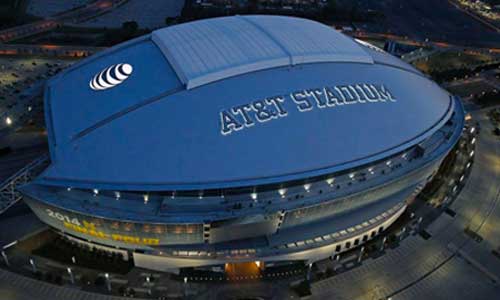
AT&T Stadium, formerly Cowboys Stadium, is a retractable roof stadium in Arlington, Texas, United States. It serves as the home of the Dallas Cowboys of the National Football League (NFL) and was completed on May 27, 2009. It is also the home of the Cotton Bowl Classic and the Big 12 Championship Game. The facility, owned by the city of Arlington, can also be used for a variety of other activities such as concerts, basketball games, soccer, college and high school football contests, rodeos, motocross, Spartan Races, and professional wrestling. It replaced the partially covered Texas Stadium, which served as the Cowboys’ home from 1971 through the 2008 season.
MatSing Network Facts
- Network deployed in 2020 within 5 months
- 20 MatSIng lens antennas provide field and seat coverage
- High Capacity low and mid band spectrum for the entrie stadium for 4×4 MIMO
With data demands of cell phones continuing to grow exponentially, driven by new apps and technology, our legacy DAS infrastructure could not keep up with those demands. AT&T introduced us to MatSing’s antenna technology, and we immediately knew their technology would give us the necessary capabilities with room to grow.