
The Network Behind Coachella: How MatSing Scaled Connectivity for a Festival in the Desert
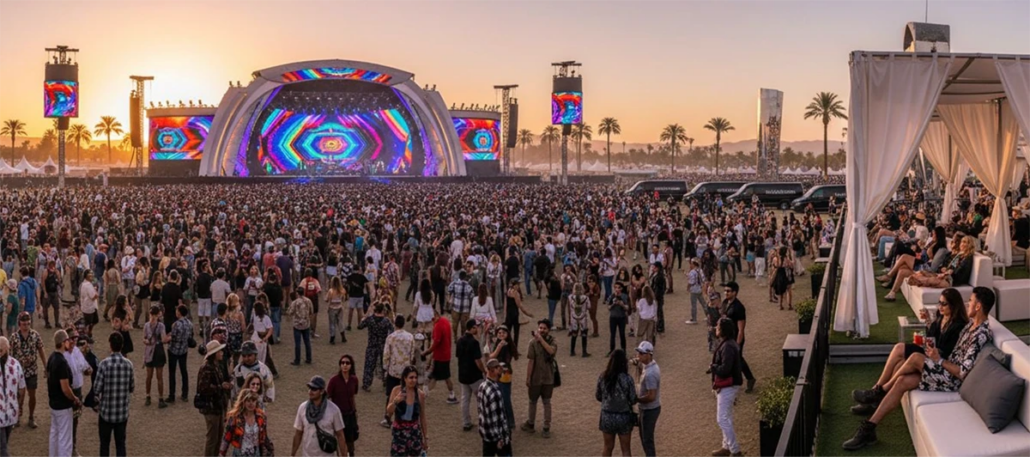
Every year, Coachella sets the stage for defining cultural moments. Massive crowds regularly bringing in 125,000 attendees, real-time sharing, and digitally driven performances now shape the experience as much as the music itself. Behind the scenes, that evolution depends on one critical factor: network performance under extreme density.
MatSing’s deployments at Coachella offer a clear case study in how wireless infrastructure has scaled to meet that demand.
From Single Antenna to Multi-Carrier System

MatSing first deployed at Coachella in 2013 with a single antenna supporting AT&T. At the time, it handled what was then considered peak mobile traffic for the event. That initial deployment proved the viability of lens antenna technology in a high-density, interference-heavy environment.
Since then, the footprint has expanded significantly:
- 2016 marked the first major capacity upgrade, introducing higher-gain antennas and multiple units to increase throughput
- 2019 expanded coverage into additional zones across the festival grounds
- 2022–2024 introduced a multi-carrier architecture, supporting AT&T, Verizon, and T-Mobile simultaneously with more targeted sectorization
Today, what began as a temporary deployment has evolved into a semi-permanent part of Coachella’s network design. Multiple MatSing antennas now support key areas across the venue, enabling consistent coverage where density peaks.
See how MatSing supports high-density connectivity at major events.
Solving the High-Density Challenge
Large-scale festivals create one of the most demanding wireless environments in the world. Tens of thousands of users attempt to upload, stream, message, and browse at the same time, often within tightly packed spaces.
MatSing’s lens antenna technology addresses several core challenges:
- Interference mitigation through precise beamforming
- Capacity scaling by segmenting coverage into targeted sectors
- Consistent performance in areas with extreme user density
Instead of relying on traditional sector antennas that can struggle with overlap and congestion, MatSing’s spherical lens design focuses signals with greater precision. This allows carriers to deliver higher data rates without sacrificing reliability.
Enabling the Modern Fan Experience
For attendees, connectivity is an essential part of the festival experience. Fans expect to share moments instantly, coordinate with friends, and access content in real time.
During the first weekend of this year’s Coachella, several high-profile performances leaned into live digital integration. Artists incorporated streaming, on-demand content, and real-time media into their sets. These moments highlight how network infrastructure now supports not just the audience, but the performance itself.
The impact shows up in everyday use cases:
- Posting from within dense crowds without delay
- Sending messages reliably across the grounds
- Streaming and uploading content as events unfold
Most users never notice the infrastructure when it works. They only notice when it fails.
A Global Model for High-Density Connectivity
Coachella reflects a broader trend in MatSing’s global deployment strategy. The company has expanded from a single-event use case into a key infrastructure provider across major venues worldwide. Its lens antennas are now deployed in stadiums, arenas, and urban environments where high user density is the norm.
This includes permanent installations in large-scale venues, where consistent performance is required year-round, not just during peak events. The same principles applied at Coachella translate directly to these environments.
Contact MatSing to learn how lens antennas support venues and live events.


Leave a Reply
Want to join the discussion?Feel free to contribute!